
Published May 28, 2019
The Hidden Tracks of Kilmar
At the dawn of the First World War, the hills around Kilmar were quiet. A few scattered farms, much forest, a dusty road. And underground — a secret that few people yet knew.
Magnesite, until then imported from Austria for a handful of minor industrial uses, suddenly became strategic. European imports had dried up. Canada needed alternatives. And Kilmar had precisely what was needed.
The numbers tell the story better than any narrative: in 1914, the ground at Kilmar gave up 358 tons of ore. Three years later, in 1917, that figure had passed 58,000 tons. A 162-fold multiplication, in the span of a war.
But how do you move that much? Horses were no longer enough. The roads broke under the weight. A railway had to be built — through dense forest, over rivers, across terrain no one had ever wanted to tame.
In 1916, that's what was built. A narrow-gauge line winding through twenty kilometers of wilderness, from the mine at Kilmar to Magnesite Junction at Marelan, where the ore would transfer to the Canadian Pacific network. They called it, at first, the Dominion Timber and Minerals Railway.
In the early days, four 15-ton steam locomotives hauled the cars. Thirty men worked the line. Some days, all four machines ran at once to keep up with demand. In the 1920s, science moved things along: researchers at the National Research Council of Canada created Magnafrit, a refractory brick capable of using even lower-grade ore. The mine got a second wind.
By 1933, industrial consolidation turned the operation into Canadian Refractories Ltd. The railway took on a new name: the Canadian Refractories Railway.
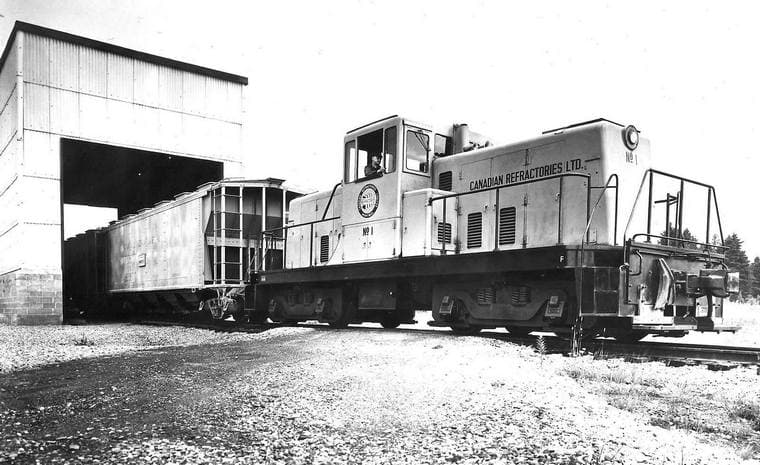
In 1951, modernization arrived: a 65-ton GE diesel-electric locomotive, 550 horsepower, replaced the steam engines. Its roar echoed across the Laurentians. It faithfully pulled ore well into the 1970s.
Then, in July 1981, the line made its last run. The rails were torn up. The ties, thrown into nearby lakes. What remained was reclaimed by paddlers, by ATV riders, by the silence of the woods taking back what was theirs.
Today, where the foundries roared, there is peace. The kilns are cold. The line is buried under moss. But its trace remains — a hidden narrative in the landscape, for those who know how to read it.
Walk the corridor of the old railway, and you become an explorer of time. The rails are gone. The story, never.
Maison Kilmar — Grenville-sur-la-Rouge, Laurentides
Book your stay →